Release time : 2026-10-13 Source :Organizing Committee
A national key R&D project titled Key Technologies and Systems for Methanol-Reforming Hydrogen Fuel Cells has successfully passed its technical performance assessment. The initiative falls under the “Inter-governmental International Science and Technology Innovation Cooperation” programme and is led by SPIC Science and Technology Research Institute Co., Ltd.
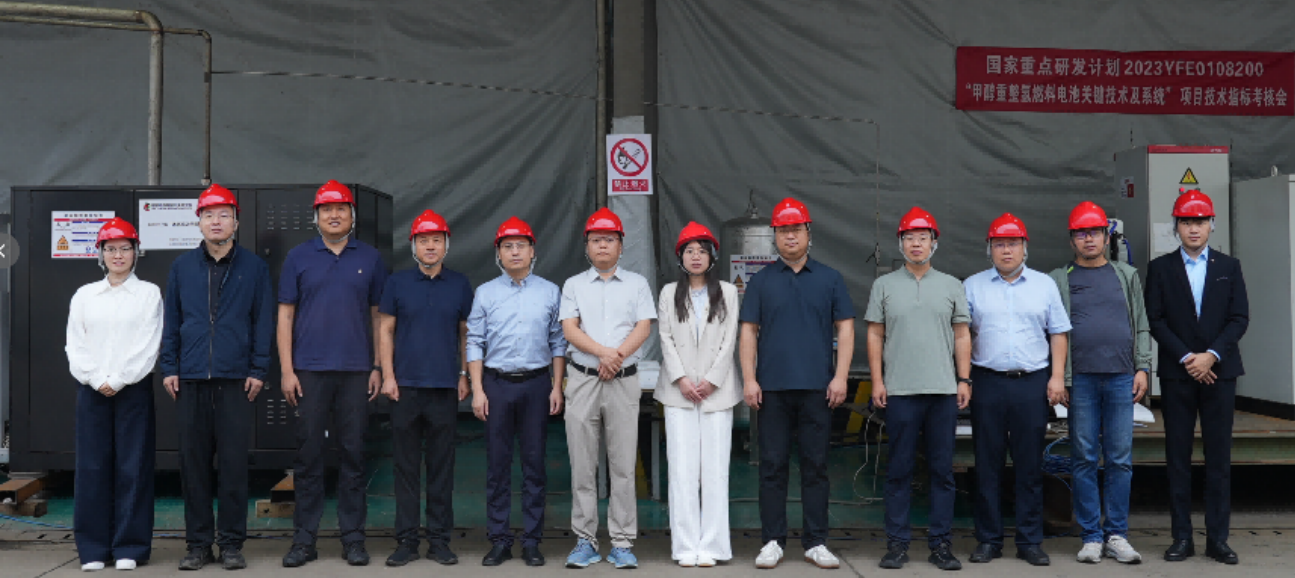
The project team has built an integrated high-efficiency methanol-reforming hydrogen-production module delivering stable hydrogen output of 40 Nm³/h. Paired with a fuel cell stack developed by the Institute of Process Engineering, Chinese Academy of Sciences, the integrated system achieves steady power generation at 40 kW.
Review experts from Beihang University, Nanjing Normal University, Shanxi University, Huairou National Laboratory and Changchun Institute of Applied Chemistry, Chinese Academy of Sciences attended the assessment session. They reviewed test reports and raw data from third-party laboratories, and witnessed live operation of the prototype system combining methanol-reforming hydrogen production and fuel cell power generation. Following presentations, questions and group deliberation, the expert panel confirmed all technical targets laid out in the project mandate have been fulfilled.
The R&D effort addresses major pain-points of conventional methanol-reforming hydrogen-making hardware: bulky footprint, high energy consumption, slow start-up response and complicated system layout, while catering to hydrogen supply needs for distributed fuel-cell power generation. The team adopted a technical pathway combining high-temperature reforming and metallic-membrane purification. The resulting equipment features high integration, fast start-up and low specific energy consumption for hydrogen production.
By optimising the coupling between membrane purification and hydrogen-generation workflows, the system requires fewer external utility supplies. Its compact build enables easy transportation and on-site deployment, making it well-suited for distributed power use-cases such as backup power stations and off-grid power facilities.
Exhibitor/Conference Consultation
Contact: Ms. Becky CHEN
Tel: +86 15910580218
Email: becky@cntigerexpo.com
Exhibitor Consultation
Contact: Mr. Lito HU
Tel: +86 13601321637
Email: lito.hu@cntigerexpo.com
Exhibitor Consultation & Media Cooperation
Contact: Ms. Yasmin ZHENG
Tel: +86 13621183385
Email: zhengyaxin@cntigerexpo.com