Release time : 2026-08-21 Source :Organizing Committee
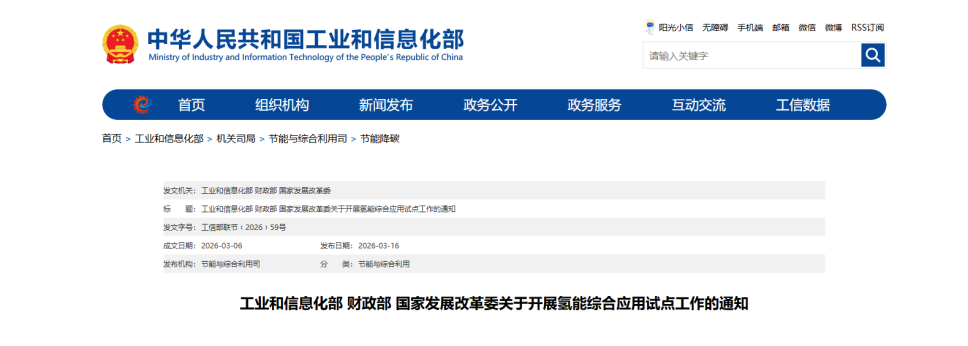
The five selected city clusters encompass Beijing-Tianjin-Hebei, the Greater Bay Area, the Northeast China(including Eastern Inner Mongolia)–Yangtze River Delta, Xinjiang–Chengdu-Chongqing Economic Circle, and the Yellow River 'Great Bend'–Central Plains region. Operating under an open-competition framework, the pilot program selects regions with solid industrial foundations, diverse application scenarios, and well-developed supply chains. The initiative focuses on the coordinated development of the entire "production, storage, transport, and utilization" value chain to address core industry constrains.
Under the pilot framework, China has set phased development targets: aiming for large-scale, multi-sector hydrogen applications by 2030, reducing the average terminal hydrogen price in participating city clusters to below RMB 25/kg—with competitive regions aiming for as low as RMB 15/kg—and doubling the nation's fuel cell vehicle (FCV) fleet compared to 2025 levels, surpassing 100,000 units.
To support the initiative, the central government will provide dedicated financial support through reward to replace subsidy. Each city cluster is eligible for up to RMB 1.6 billion in performance-based rewards over the four-year pilot period, with funds specifically allocated to industrial development and reducing end-user hydrogen costs. The framework establishes a "1+N+X" application ecosystem—using fuel cell vehicles as a foundational baseline, scaling up industrial applications in green metallurgy and green ammonia/methanol, and exploring innovative scenarios in maritime and rail transport.
While China's hydrogen industry has completed its zero-to-one breakthrough and established a foundational supply chain framework, challenges such as high hydrogen costs and limited utilization scenarios persist. Through regional collaboration, scenario-driven demand, and policy support, this pilot program aims to clear supply chain constrains, cultivate new drivers for the green economy, and support China's dual-carbon goals and traditional industrial transformation.
Exhibitor/Conference Consultation
Contact: Ms. Becky CHEN
Tel: +86 15910580218
Email: becky@cntigerexpo.com
Exhibitor Consultation
Contact: Mr. Lito HU
Tel: +86 13601321637
Email: lito.hu@cntigerexpo.com
Exhibitor Consultation & Media Cooperation
Contact: Ms. Yasmin ZHENG
Tel: +86 13621183385
Email: zhengyaxin@cntigerexpo.com