Release time : 2026-09-11 Source :Organizing Committee
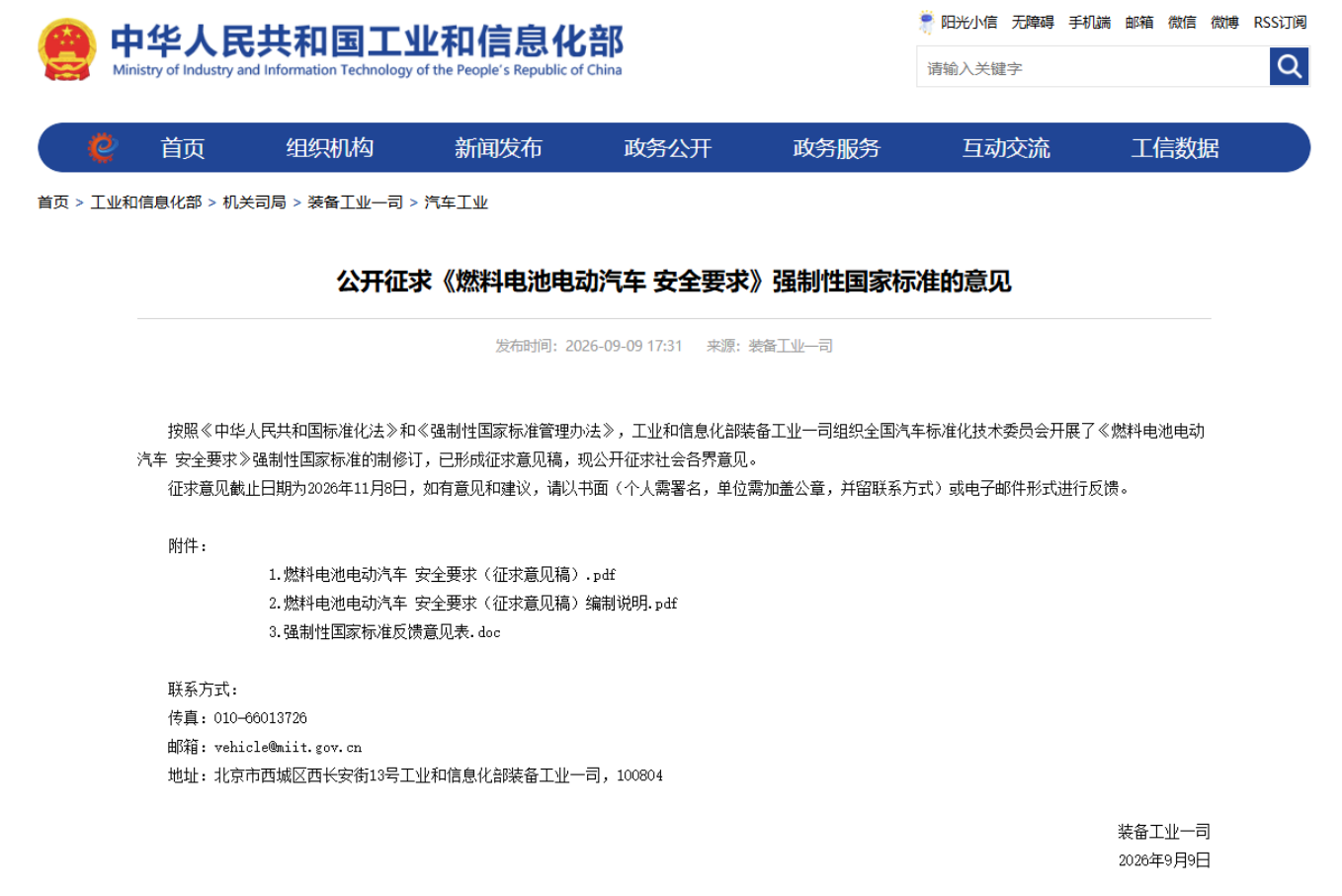
BEIJING — On September 9th, the Department of Equipment Industry I under the Ministry of Industry and Information Technology (MIIT), in collaboration with the National Technical Committee of Auto Standardization, finalized the draft of the mandatory national standard Fuel cell electric vehicles—Safety requirements and officially opened it for public comment through November 8th, 2026.
The formulation and revision of this standard aim to align with the scaling commercial deployment of fuel cell vehicles (FCVs). As China's hydrogen demonstration city clusters advance, operations of fuel cell commercial vehicles and medium-to-heavy-duty freight trucks are expanding onto urban arterial roads and highways, increasing operational environment complexity. Concurrently, the vehicle integration of advanced technologies—such as 70 MPa high-pressure hydrogen storage and refueling communication protocols—alongside real-world operating scenarios involving hydrogen emission controls under heat engine operating conditions and human-machine interactions during refueling, has raised the baseline for vehicle-level standardization. Prior standards governing the sector were voluntary, leaving key clauses insufficient for current technological iterations and safety governance needs.
Focusing on core operational safety elements, the revised standard elevates road-tested technical specifications into mandatory baseline requirements, optimizing technical metrics across key domains:
Vehicle-Level Hydrogen Leakage and Emission Controls: Establishes explicit prevention requirements for hydrogen leakage and sets strict concentration limits for hydrogen exhaust across diverse operating states, including heat engine operating conditions.
Onboard Hydrogen Storage System Safety: Raises reliability and safety benchmarks for onboard storage components and piping systems to mitigate systemic safety risks.
Refueling Signal Interaction: Standardizes refueling communication protocols and signal interaction parameters to ensure operational safety during fueling.
Once enacted, this mandatory national standard will serve as a compulsory regulatory threshold for vehicle market access and manufacturing. It will standardize R&D and production across upstream and downstream supply chains—including complete vehicles, onboard storage systems, and refueling interface hardware—providing standardized safety enforcement for mass commercial FCV deployment.
(Compiled from the Ministry of Industry and Information Technology (MIIT) of China)
Exhibitor/Conference Consultation
Contact: Ms. Becky CHEN
Tel: +86 15910580218
Email: becky@cntigerexpo.com
Exhibitor Consultation
Contact: Mr. Lito HU
Tel: +86 13601321637
Email: lito.hu@cntigerexpo.com
Exhibitor Consultation & Media Cooperation
Contact: Ms. Yasmin ZHENG
Tel: +86 13621183385
Email: zhengyaxin@cntigerexpo.com