

Release time : 2026-09-28 Source :Organizing Committee
NANTONG, China — September 27, 2026 — Tiejian Daqiao Pile-1, the world’s largest pile-driving vessel, has departed from the foreign-trade terminal at Lüsi Port in Jiangsu Province for All Saints Bay in Bahia State, Brazil, where it will support construction of the Salvador Cross-Sea Bridge, described as Latin America’s largest sea-crossing cable-stayed bridge.
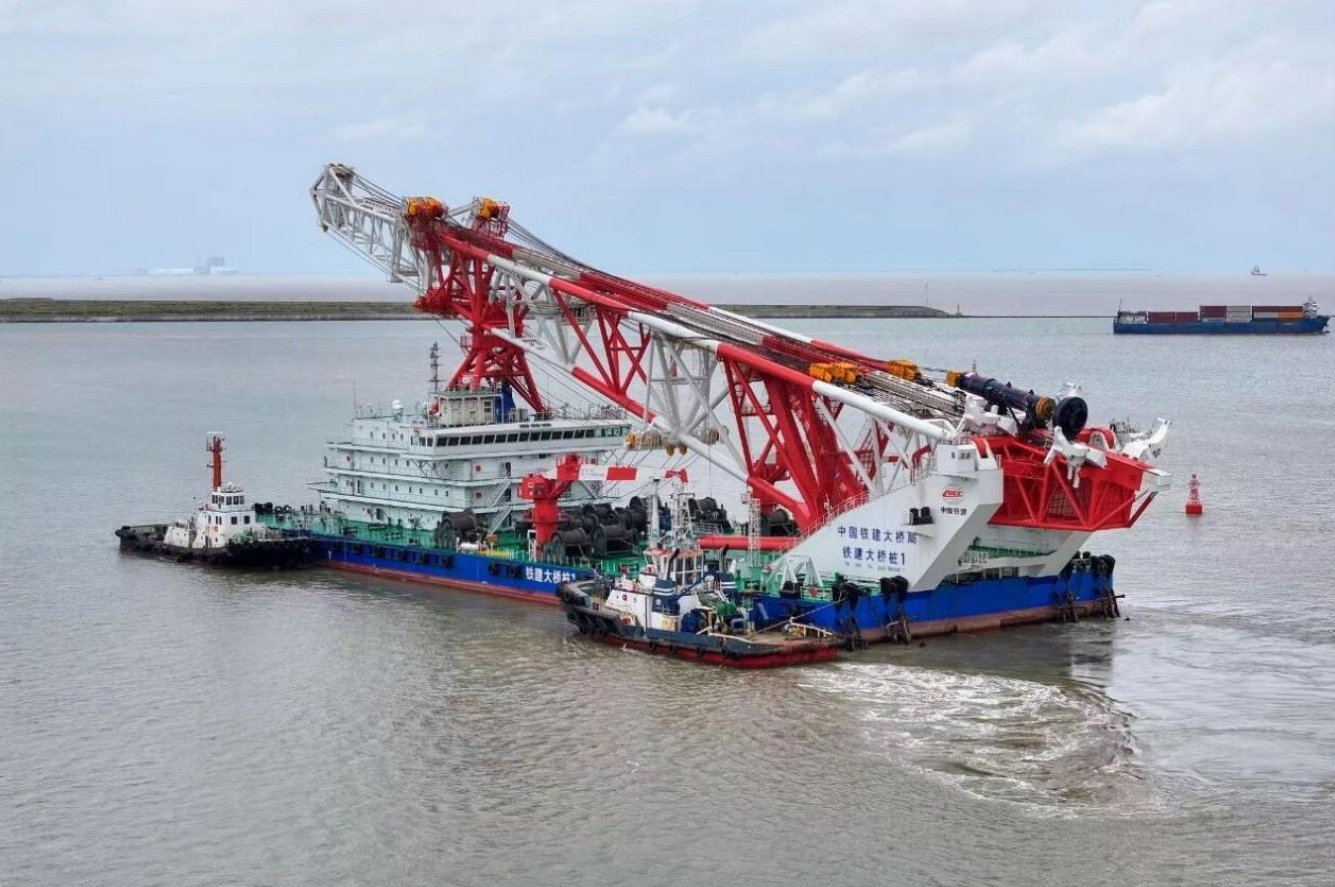
Invested in and built by China Railway Construction Bridge Engineering Bureau, the vessel will travel from the Yangtze River estuary through the Strait of Malacca and around the Cape of Good Hope before entering the South Atlantic and reaching waters off Recife on Brazil’s northeastern coast. The 11,300-nautical-mile voyage is expected to take about 45 days.
Before departure, the ship and shore teams completed dedicated operational planning, route surveys and risk assessments, with the vessel’s journey to be monitored dynamically throughout the voyage.
The Salvador Cross-Sea Bridge spans All Saints Bay, Brazil’s largest bay, and features pile foundations installed in some of the deepest waters for a sea-crossing bridge. Water depth at the main bridge piling area reaches 64 metres, amid complex marine geological conditions.
Tiejian Daqiao Pile-1 is a domestically designed and built pile-driving vessel measuring 130.5 metres in length, with a 156-metre-high pile frame and a maximum pile-lifting capacity of 700 tonnes. It can drive piles up to 7 metres in diameter and operate in waters as deep as 70 metres.
The vessel is equipped with the world’s tallest pile frame, the highest pile-lifting capacity and the deepest operating water depth among vessels of its type. It is designed to overcome the limitations of conventional piling equipment in deep and offshore waters, including limited reach, positioning challenges and difficulties maintaining stability in complex marine conditions.
The vessel incorporates two technologies described as world firsts.
For the first time on a large pile-driving vessel, a hybrid positioning system combining dynamic positioning (DP) and mooring anchoring has been deployed. The mooring system secures the vessel through anchors positioned at its four corners, while the DP system continuously detects wind, wave and current conditions. Bow and stern thrusters then provide counter-thrust to make precise adjustments to the vessel’s position.
Combined with China’s BeiDou high-precision satellite positioning system, the technology enables piling positioning accuracy at the centimetre level.
The vessel also features a closed-loop hydraulic system for its main cylinders, developed and manufactured domestically. The system converts potential energy generated when the pile frame is lowered or tilted forward into electricity, achieving an energy recovery rate of 40%.
The Salvador Cross-Sea Bridge is being financed, constructed and operated by a concession company jointly established by China Civil Engineering Construction Corporation, a subsidiary of China Railway Construction Corporation, and three other shareholders.
The bridge will have a main span of 682 metres and a total length of 46.8 kilometres. Once completed and opened to traffic, it is expected to reduce travel time between Salvador and Vera Cruz from about one hour by ferry to approximately 15 minutes. It will also shorten transport distances for grain, cotton, fruit and other commodities produced in western Bahia State by 200 kilometres.
Exhibitor/Conference Consultation
Contact: Ms. Becky CHEN
Tel: +86 15910580218
Email: becky@cntigerexpo.com
Exhibitor Consultation
Contact: Mr. Lito HU
Tel: +86 13601321637
Email: lito.hu@cntigerexpo.com
Exhibitor Consultation & Media Cooperation
Contact: Ms. Yasmin ZHENG
Tel: +86 13621183385
Email: zhengyaxin@cntigerexpo.com