Release time : 2026-09-29 Source :Organizing Committee
RIZHAO, September 28th — The first-of-its-kind Thermal-Coupled Seawater-to-Hydrogen System with Critical Element Co-Production, located in Rizhao, surpassed 1,000 hours of continuous and stable operation. The milestone was formally verified and approved by an evaluation panel comprising five CAS/CAE academicians and industry specialists.
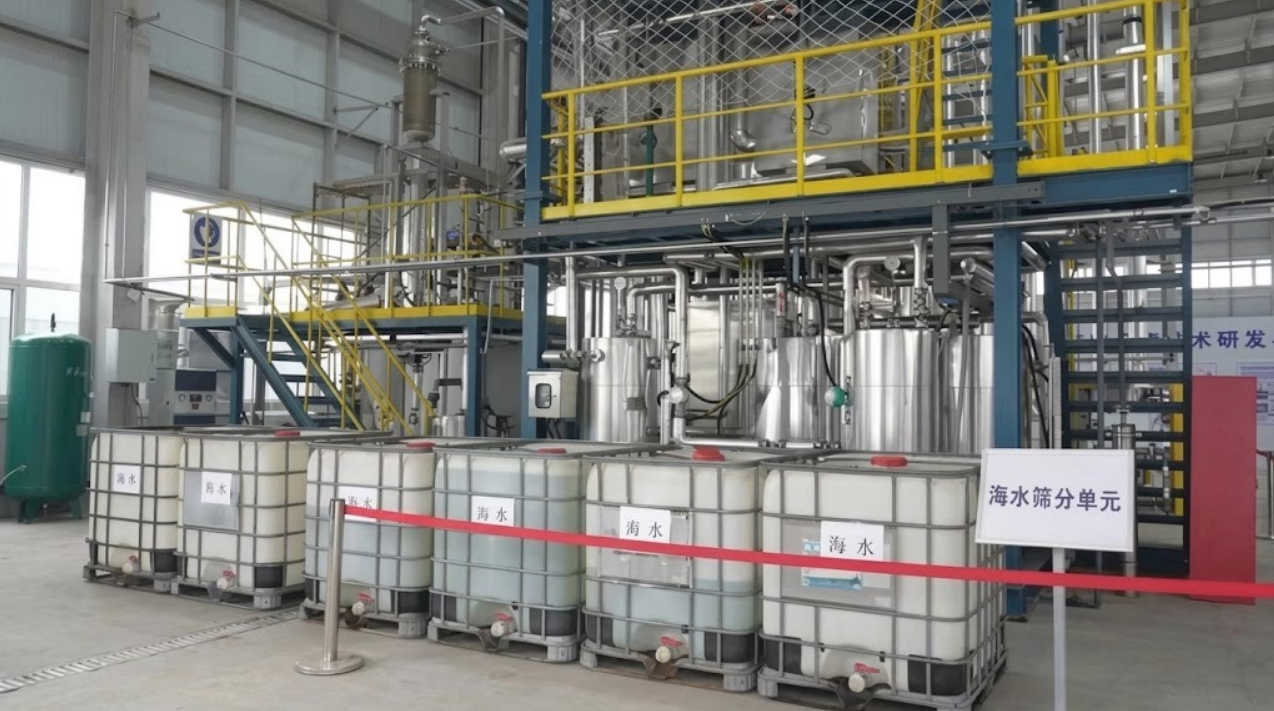
Jointly developed by Laoshan Laboratory, the Rizhao Municipal Government, China General Nuclear Power Corporation (CGN), and Shandong Normal University, the system utilizes raw seawater as feedstock. By recycling low-grade industrial surplus heat from coastal plants alongside the electrolytic reaction's own heat, and extracting critical elements in-situ via continuous flow reactions, the technology successfully resolves two major industry constrains: electrode failure caused by calcium and magnesium scaling, and reduced equipment lifespan alongside high power consumption driven by chloride ion corrosion.
Operational metrics confirm that the unit produces 30 Nm3/h of ultra-pure hydrogen (purity ≥ 99.999%) while processing approximately 800 tonnes of seawater annually. At full capacity, annual output is projected at 260,000 Nm3 of ultra-pure hydrogen, accompanied by co-produced critical elements reaching a purity of 99.8%. Financial modeling indicates that under commercial-scale operation, at electricity tariffs of RMB 0.55/kWh, RMB 0.40/kWh, and RMB 0.35/kWh, the integrated Levelized Cost of Hydrogen (LCOH) drops to RMB 22.21/kg, RMB 12.99/kg, and RMB 9.92/kg, respectively.
Source: Rizhao Daily
Exhibitor/Conference Consultation
Contact: Ms. Becky CHEN
Tel: +86 15910580218
Email: becky@cntigerexpo.com
Exhibitor Consultation
Contact: Mr. Lito HU
Tel: +86 13601321637
Email: lito.hu@cntigerexpo.com
Exhibitor Consultation & Media Cooperation
Contact: Ms. Yasmin ZHENG
Tel: +86 13621183385
Email: zhengyaxin@cntigerexpo.com